
Last week, I made the same offer for the fiftieth time. That number caught me by surprise.
What started years ago as a simple conversation with the child of a close friend has quietly become one of the longest-running traditions in my life. Every year or two, another thirteen-year-old reaches the age where childhood starts giving way to something else, and I find myself sitting across from them and their parents, hoping the conversation might hand them something I never had: a head start.
Sometimes we're gathered around a kitchen island. Other times it's a family room after dinner, the dishes still sitting in the sink while everyone settles in. The setting changes, but the ritual rarely does.
The parents know about the books. They know about the $500. They know there's another conversation afterward. What they don't know is that they're about to become part of it.
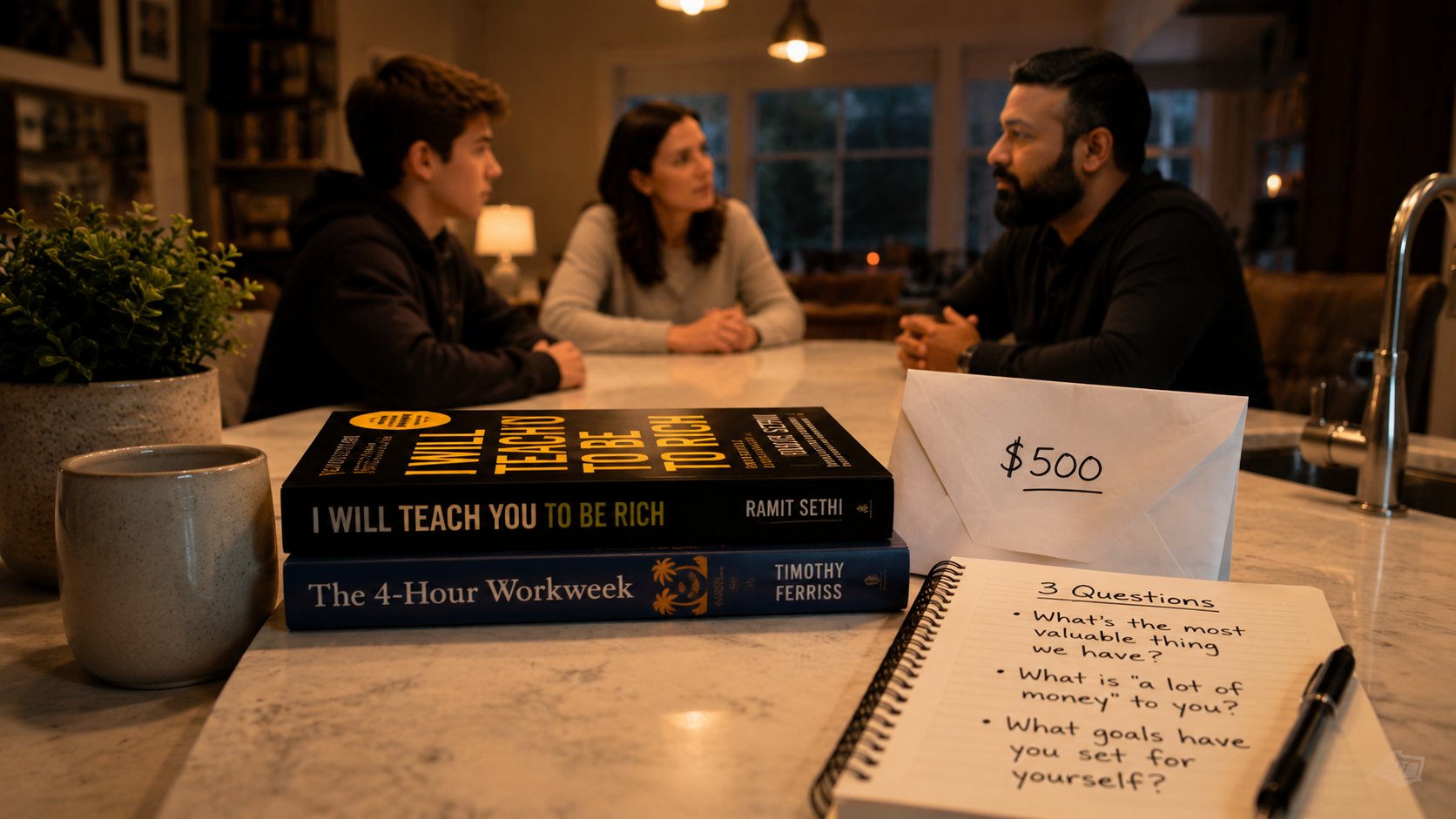
The deal itself is simple. Read both books, come back and talk to me about what you learned, and the $500 is yours. No test, no trick. Just the books and a conversation.
The books are I Will Teach You to Be Rich by Ramit Sethi and The 4-Hour Workweek by Tim Ferriss. Once they've finished reading, we meet again. They tell me what they learned, answer whatever questions I ask, and explain how they'd use the money. Whether they choose to invest it, save it, or put it toward a business idea isn't what I'm evaluating. Their parents always have oversight over whatever happens next.
What matters is the thinking behind the decision. Can they connect what they read to the choices they want to make? Can they explain their reasoning? Can they defend it when someone respectfully challenges them?
Before any of that, I ask three questions:
- What's the most valuable thing we have?
- What does "a lot of money" mean to you?
- What goals have you actually set for yourself?
Most kids answer quickly, a little unsure, watching my face to see whether they got it right. That's fine. The questions aren't a test. The offer is the door; the questions are what waits on the other side.
I've asked those questions fifty times now, and I've never heard the same conversation twice. That's because the questions aren't really about money. They're about perspective, and perspective has a way of surprising people.
Parents hear answers from their children they've never heard before. Husbands and wives realize they've been carrying around different definitions of success for years without ever talking about them. Sometimes the kids are surprised by their parents. Just as often, the parents are surprised by each other.
None of them walks into the room expecting that.
Most people assume I'm there to mentor the thirteen-year-old. In reality, the whole family becomes part of the conversation, and everyone leaves with something to think about.
One family answered the question about money like this: the father said $500,000, his wife said $10 million, their oldest child said a few hundred dollars, and their youngest landed somewhere around a few thousand.
When the mother answered, she looked a little self-conscious. Compared with everyone else's responses, $10 million sounded enormous. Her husband laughed, then stopped and thought about it.
"You know," he said, "she's right. Ten million dollars is a lot of money."
After another pause, he added, "I've just never thought of that as possible. Five hundred thousand always felt achievable."
That realization stayed with me because he hadn't misunderstood the question. He had quietly answered a different one.
Not What is a lot of money?
But What do I believe is a lot of money and still realistically possible for someone like me?
Those are not the same question. Without realizing it, he had added a condition. His answer wasn't based only on what he considered significant. It was also limited by what he believed he could realistically achieve.
I don't think he noticed that limit until he heard himself say it aloud.
That conversation changed the way I think about goals and leadership. We often assume people are being realistic when they describe what they want, but sometimes they are simply staying within a ceiling they stopped noticing years ago. The limit may have been built by fear, failure, circumstance, or the expectations of someone whose voice still carries more weight than it deserves.
Since then, when someone tells me something isn't possible, I try to ask a better question: is it actually impossible, or has it simply never felt possible?
A different family taught me another lesson.
The father said $1 million was a lot of money. His wife said $100,000. Their oldest child said $500, and their middle child said $200. Then the youngest confidently announced that $500 wasn't much money because it wouldn't even buy the Jordan sneakers he wanted.
The room went quiet. I'll admit that my first reaction was disappointment.
Then I asked why he wanted those particular shoes.
He looked at me as if the answer should have been obvious.
"So I can flip them."
In less than a minute, I had heard an answer, assigned a motive to it, and misunderstood the thinking behind it. He wasn't approaching the shoes as a consumer. He was looking at them as inventory.
My disappointment turned into pride, but the more important lesson was about my own reaction. Had I corrected him instead of asking one more question, I would have missed the entrepreneurial thinking sitting right in front of me.
I've carried that lesson into leadership meetings, interviews, client conversations, and disagreements ever since. Assumptions close conversations before understanding has a chance to enter them. Curiosity keeps the door open.
One more question often teaches me more than one more opinion ever could.
Most kids say yes to the offer immediately. Some start mentally spending the money before I've finished explaining the rules. Others barely react, which usually tells me we may need to spend more time discussing the value of money than I originally planned.
Then life happens. School, sports, friends, phones, summer, and everything else competing for a thirteen-year-old's attention gradually push the books to the bottom of the priority list. They move from the nightstand to a shelf, then into a drawer, and eventually out of mind.
Out of fifty kids, only three finished.
Most people assume that's the disappointing part of the story. I don't, and it took me a while to understand why.
The Question I Learned to Dread
Years later, something started happening that I had not expected. I had assumed the kids who didn't finish had forgotten the whole thing: the books, the offer, the conversation at their kitchen table.
They hadn't.
The kids who had not finished began reaching back out. They had gone off to college, started their first jobs, or found themselves learning about investing, entrepreneurship, or the quiet panic that can accompany a first real paycheck. Somewhere along the way, they remembered two books and an offer they had passed up years earlier.
Almost every conversation began the same way.
"Is the offer still good?"
The first time, it caught me completely off guard. After that, I knew what was coming as soon as I recognized the name. Knowing did not make it easier to answer, because I always said no.
Not to punish them. I want to be clear about that. I didn't need to. Life had already handled that part.
Instead, I asked what had changed. Their answers were remarkably consistent:
- "I get it now."
- "I didn't realize how valuable those books would've been."
- "I wish I'd done it."
What struck me was that they didn't really want the money. They wanted the years back. They wanted the head start. Those are very different things.
One of the hardest lessons we learn as adults is that some opportunities don't disappear because we fail at them. They disappear because we wait.
Some opportunities don't disappear because we fail. They disappear because we wait.
Before we hung up, I asked one final question: "Are you going to read the books anyway?"
Every one of them said yes. I hope they did.
I never followed up, and I have made my peace with not knowing. At some point, mentorship has to leave room for people to choose their own path. If I chase them down to check, I have turned a gift back into an assignment.
The Girl Who Came Back With Better Questions
There was one exception, and I only know about it because she called me.
She wasn't one of the three. She didn't finish the books that year, or the year after. She read them anyway, a few years later, on her own.
She had taken money she earned tutoring, added birthday money and savings she had accumulated over the years, and started investing it. By the time we talked, the portfolio she built had grown from around $15,000 to more than $30,000.
She never asked whether the offer was still good. That wasn't why she called.
I was proud beyond words, but not because the number had doubled. What stayed with me wasn't the money. It was her questions.
Years earlier, she wanted to know what she should buy. Now she wanted to know how I decide:
- Why this investment instead of that one?
- What makes something worth pursuing?
- How do you think about risk?
- How do you know when to be patient?
Somewhere along the way, her questions stopped being about stocks. They became questions about judgment. She wasn't asking me for an answer anymore. She was asking how to build her own.
That reminded me of something every leader eventually learns, usually later than they would like: the goal is not to become someone people depend on for answers. It is to help them develop the confidence and judgment to find their own.
Advice is seductive because giving it makes us feel useful. But advice solves today's problem and nothing else.
Advice solves today's problem. Learning how to think solves the next hundred.
That is a far better return than anything $500 could buy, and it is the return many of us forget to invest in when we lead. We answer the question in front of us because it is faster. We tell people what we would do because watching them work through it is slower, messier, and forces us to sit with the discomfort of their learning.
Every time we hand someone our answer, though, we risk taking away the opportunity to build the judgment that could eventually produce a hundred answers of their own. That experience forced me to ask a question I still find uncomfortable: how often am I solving the problem when I should be teaching the thinking?

Why I Keep Making an Offer That Mostly Fails
People ask why I continue making the offer when only three kids out of fifty have completed it. The honest answer has almost nothing to do with the books or the money. It has everything to do with thirteen-year-old me.
Very few adults believed in me. I could count them on one hand, and I have thought about that number more than I expected to. The ones who did believe in me changed the direction of my life. The ones who didn't delivered the same message in different words, and it always came down to the same sentence: I wasn't good enough.
One teacher told me I shouldn't go to college. Another kept me out of advanced classes for reasons that had nothing to do with my ability and everything to do with assumptions he had already made about students who looked like me. A third was months from retirement and long past caring. He failed everyone in the room, and the school's response was to stop approving transfers rather than deal with the class. The semester that came out of that helped close the door on the college I most wanted to attend.
It took me years to notice what those three had in common. All of them taught English.
This is not a story about one unlucky kid. My closest friend earned straight A's in every subject from kindergarten forward. He did not graduate.
Then I got to college, and my English professors told me I should publish my work. One of them put a piece of mine in the school magazine. Same subject, same skill, two completely different verdicts. For a long time I assumed one of them had to be wrong, and I quietly assumed it was the professors.
When you're a child, you don't yet have the life experience to separate someone else's opinion from your own potential. When an adult in authority tells you what you're capable of, especially repeatedly, you do not always hear it as one person's limited perspective.
You hear it as a verdict.
For a long time, I did.
It took me years to ask who had written that verdict. Looking back, I can see how many of the ceilings I carried into adulthood were never actually mine. They belonged to someone else. I simply agreed to hold them.
I also learned that education is not the equal experience we often pretend it is. Some children are taught to question, create, and lead. Others are taught to follow instructions, stay inside the lines, and accept the expectations placed on them. The difference is not always ability. Sometimes it is the school, the teacher, the resources, or whether a single adult chooses to see potential instead of a stereotype.
Almost everything that ended up shaping my career, from leadership and technology to business, finance, and communication, arrived later. Very little of it came from a classroom. It came from books, mentors, failure, curiosity, and years of teaching myself because I did not know another option existed.
That is why this tradition means what it does to me. I cannot go back and become the mentor that kid needed. I cannot undo the discouragement or give myself the conversations I wish someone had taken the time to have.
But I can sit across a table from another thirteen-year-old and try to give them something better than I received. Not answers. Not guarantees. A different perspective, some encouragement, and a chance to learn a few important lessons earlier than I did.
Maybe that is what mentorship really is: trying to shorten someone else's learning curve by giving them some of your experience before life forces them to earn all of it the hard way.
Time Was Always the Lesson
I want to be precise about something. I never started this because I wanted to teach teenagers about money.
I wanted to help them prepare for their future. I wanted them to understand the importance of time and how to make better use of it while they still had so much of it ahead of them. Money matters because it can create choices, and those choices can create freedom over how we spend our time.
The books and the $500 gave us a reason to sit down and begin the conversation.
Time was always the lesson.
That is why my answer to the first question has never changed. What's the most valuable thing we have?
I've heard people say family, health, freedom, relationships, and love. They are all meaningful answers.
Mine has always been time.
Money can be earned again. Businesses can fail and be rebuilt. Knowledge can be acquired later, even if slowly. Time is the one thing that moves in a single direction, and it does not take requests.
One of my favorite lines comes from Neil Gaiman's The Sandman: "You lived what anybody gets. You got a lifetime. No more. No less."
I think about that often, and never more than when I am sitting across from a thirteen-year-old who has no idea how valuable the next ten years of their life are going to be.
Somewhere along the way, I realized those three questions had stopped being only for the kids. They had quietly become questions I ask myself:
- Am I spending my time on what actually matters?
- Have I lowered my definition of what's possible without noticing?
- Am I still setting goals big enough to make me uncomfortable?
- Have I accepted ceilings that do not really exist?
- Am I teaching the people around me how to think, or simply handing them my answers?
Those questions have made this tradition as valuable to me as I hope it has been to anyone else.
Every year or two, another thirteen-year-old sits across from me. We talk about books, money, time, goals, and whatever else those three questions uncover. The answers are always different, and they still surprise me after fifty conversations.
I know most of them will not finish the books, and I know the $500 will not change every life. That was never the promise.
The hope is simpler.
I hope one young person walks away knowing that an adult believes in them before they have accomplished anything. I hope they see one possibility they had not considered before, question one limitation they had quietly accepted, or learn one lesson a few years earlier than they otherwise would have.
Most of all, I hope they understand that their future does not have to be limited by the expectations someone else placed on them.
That is the responsibility I believe every generation has to the next:
- Help them start where we finished.
- Give them the lessons that took us decades to learn.
- Encourage them to dream bigger than we did.
- Believe in them before they have done anything to prove that belief was justified.
That is what I have been trying to do across fifty conversations, and it is why I will keep making the offer. Not because I know it will change every life, but because I know exactly what it feels like when someone believes in yours.
Last week, after the fiftieth conversation, I did the math. Fifty conversations at $500 each meant I'd been willing to give away $25,000 over the years.
That's what the spreadsheet says. I don't think it's accurate.
The money was never the investment. The investment was the belief, the questions, the conversations, and the hope that one teenager might begin thinking differently decades before I did.
By the time I made the offer for the fiftieth time, I understood I was never really offering $500. I was offering an earlier version of lessons that had taken me decades to learn.
That's worth infinitely more than $25,000.
You do not need $500 or two books to make that kind of investment. You can mentor someone, share what experience has taught you, ask a question that expands their thinking, or simply tell them that you see potential they may not yet see in themselves.
Perhaps that is what mentorship really is: investing a little of your lifetime so someone else can make better use of theirs.
And perhaps the next time I sit across from a thirteen-year-old, somewhere between the books, the $500, and the three questions, they will leave with something I wish someone had given me much earlier: a different way of thinking, a little more belief, and a head start.
So I will leave you with the same three questions I have asked fifty families over the years:
- What is the most valuable thing we have?
- What is "a lot of money" to you?
- What goals have you set for yourself?
I would encourage you to answer them honestly.
Better yet, ask them around your own dinner table. You might be surprised by the conversation that follows, and by what the people closest to you have been thinking all along.
Want more insights like this?
Subscribe to get weekly leadership tips, frameworks, and practical advice delivered to your inbox.
Subscribe for Updates